
The $650,000 Question
A household on the median $90,000 income can afford about $650,000. Prices are falling but building costs aren't, and the correction is forecast to end around mid-2027. Can we get homes to that price before it does?

For the first time in years, Australian housing has stopped moving in the direction that makes reform impossible.
Prices have fallen five months running. Listings have surged across Sydney and Melbourne. Perth, which spent two years as the tightest market in the country, is watching stock build sharply. Buyers who spent 2024 and 2025 being outbid are circling again, and on the property forums the mood has shifted from despair to something closer to calculation — thread after thread reading the fifth consecutive monthly fall as a rare and closing window.
They are right that it is a window. What is less understood is what it is a window for.
−7.3%Westpac's forecast peak-to-trough fall in national dwelling prices, before growth of 3% in 2027 and 8% in 2028.
Westpac expects the trough at around seven per cent, then three per cent growth in 2027 and eight in 2028.1 Luci Ellis's team has Sydney down 10.4 per cent peak to trough, Melbourne 8.6, Perth 4.8, Brisbane 4.0, Adelaide 2.1. The correction is real, uneven, and finite. Somewhere around the middle of next year the arithmetic that has driven Australian housing for thirty years reasserts itself, and the country goes back to arguing about affordability while paying more for it.
That gives us about twelve months. What gets done with them is the entire question.
What everyone actually agrees on
Anthony Miller's contribution — and Tom Panos was right that it cut through — was to say the obvious thing in a room that had stopped saying it. Australia does not have a housing demand problem. It has never had a housing demand problem. It has a problem building enough homes at a price ordinary earners can service.
Miller put a figure on it: roughly $650,000 for a household on the median income of about $90,000, if responsible lending standards mean anything at all.2 That number is the most useful thing anyone has offered this year, because it is a target rather than a grievance. It is checkable. It is either being hit or it is not.
Mostly it is not.
The May budget lifted capital gains tax on investors and confined negative gearing to new builds. Reasonable people can argue the merits. What is not arguable is the mechanism: those measures change who buys the existing stock. They do not change how much stock exists. Miller's own loan book showed it within months — owner-occupier applications down two per cent, investor applications down 26, first home buyer applications down 30. The composition of the queue changed. Its length did not.
And we have the receipts on demand-side stimulus, because we ran that experiment at national scale. More than 300,000 Australians have now bought a first home on a five per cent deposit under the federal guarantee.3 A great many bought into a market that policy was explicitly designed to cool. Some are in negative equity. More are in what brokers have started calling mortgage prison — technically able to refinance, practically unable to, because leaving a participating lender means paying the lenders mortgage insurance the scheme waived in the first place.
~$31,000Canstar's estimate of LMI on a $600,000 loan.4 The exit toll on a scheme sold as a shortcut in.
That is the case against subsidising demand, and it is not theoretical. It has names attached to it.
The paradox that keeps getting posted
The reply that lands under every supply-side argument online is the same one, and it is a fair question. If the shortage is so severe, why are the builders going broke?
Bathla is the case everyone cites: around $3.4 billion owed, more than 2,000 apartments frozen, a further 14,000 homes in a pipeline now in doubt.5 It is not an outlier. In the year to June, 3,472 construction companies failed — one in every four corporate insolvencies in the country — and roughly 63 per cent of building company collapses are small builders.6
24.5%Construction's share of all Australian corporate insolvencies in FY26, in the middle of a record housing shortage.
The paradox dissolves the moment you separate two things that sound identical. There is enormous demand for homes. There is very little demand for homes at prices that cover what it now costs to produce them. House construction costs sit about 51 per cent above pre-COVID levels. Fixed-price contracts pushed that risk onto the party least able to carry it. Financiers require presales — often 80 per cent of stock — before an apartment project can start, and investors write a large share of those presales, which is the transmission line running directly from a tax change to an empty building site.
A shortage and a wave of insolvencies are not contradictory. They are the same fact seen from opposite ends. The distance between what a home costs to build and what a median earner can pay for it is not a moral failing to be scolded out of the market. It is an arithmetic problem, and arithmetic problems have solutions.
Where the money in a new house actually goes
Here is the number that belongs at the centre of this debate and almost never appears in it.
The Centre for International Economics, working for the HIA, priced a Sydney greenfield house-and-land package at roughly $1.18 million and found 49 per cent of it — about $576,000 — was regulatory costs, statutory taxes and infrastructure charges.7 Not land. Not labour. Not materials. Melbourne came in at 43 per cent, Brisbane 41, Adelaide and Hobart 37, Perth 36.
Close to half the price of a new home on Sydney's fringe is government, before a single brick is laid.
That reframes the whole proposition. Miller asked whether it would be better to defray the cost of certain materials than to subsidise buyers. The honest answer is that materials are the smallest prize on the table. The largest is the take — and the way we make one household carry it.
What we are actually doing to the first buyer
Miller made a further point that drew less attention than it deserved, and it is the most important thing he said.
Roads, water, sewerage and utility connections — the works that turn a paddock into an address — can run to something like 30 per cent of the cost of a new property. He asked exactly the right question about it: should that fall to the new homeowner, or is it something that should be shared across the community?
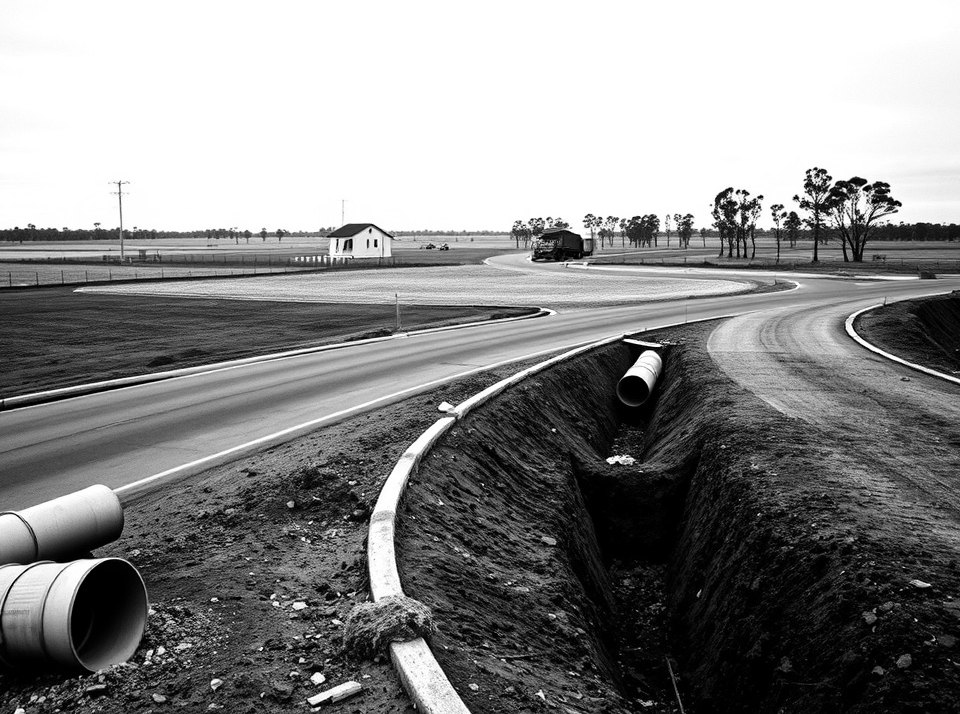
Consider what our current answer means in practice. A sewer main has a design life of a century. A distributor road, a water reticulation network, a substation: these are assets that will serve the first household, and the twelve households that follow it, and the ones after those. We fund them by loading their full cost into the purchase price of the first home built above them. The first buyer pays for a hundred-year asset over a thirty-year term, at mortgage rates, with stamp duty charged on top of the infrastructure component and GST embedded underneath it.
That is not really a subsidy question. It is a term mismatch, and it is indefensible on its own accounting. Correcting it is not a handout — it is matching the funding term to the life of the asset, which is what governments do for every other piece of infrastructure they own. We do not ask the first commuter on a new rail line to fund the tunnel.
This also answers the strongest objection to supply-side support, which economists will raise the moment it is proposed and which deserves a straight answer rather than a dismissal. Hand a developer cash and much of it ends up in the land price, because development sites are valued residually: lower a cost and you raise what a bidder can pay for the dirt. Prosper Australia's work on rezoning windfalls makes the point brutally — after Fisherman's Bend was rezoned, approved sites recorded average land value uplift of 368 per cent, captured almost entirely by whoever happened to own the land.8
But that critique bites hardest on cash rebates and weakest on infrastructure delivered as infrastructure. If the state builds and owns the trunk servicing and recovers it across the asset's life from everyone who uses it, there is no cheque for a landowner to bid away. There is a pipe. Pair that with any material support paid on completion rather than approval, so money only moves once a home exists, and the capitalisation problem largely dissolves. Design it as a per-lot grant instead and it does not.
That distinction is the difference between a policy that builds houses and one that inflates land, and it is worth getting right the first time.
You still cannot subsidise a plumber who does not exist
None of it works alone, and this is where the optimism has to stay honest.
In Perth, industry analysis puts around 10,000 approved apartments sitting unbuilt, with more than a third of approved projects stalled for a single reason: there is nobody available to build them. The HIA's Trades Availability Index for the Perth metro sat near minus 0.79 in the June quarter, worse than the national average.9 Average residential build times in Western Australia have stretched by more than 70 per cent since 2020. The National Housing Supply and Affordability Council now expects the 1.2 million target to slip to December 2030, with NSW possibly running to March 2032.10
Those homes have consent. They have proven demand. What they lack is capacity.
And there is an irony inside Miller's own optimism that has gone unremarked. He was upbeat about the investment cycle — data centres, defence, rare earths, renewable infrastructure, consumption holding up better than anyone forecast. He is right, and that boom is precisely why the country can afford to fund housing infrastructure properly rather than pleading poverty. It is also, right now, the residential sector's most effective competitor for tradespeople, bidding wages up on the exact workforce that would otherwise be pouring slabs in Wanneroo and Werribee.
No materials rebate fixes that. You fix it by treating trade capacity as infrastructure too: funding completions rather than enrolments, and accepting that this is the one lever whose benefits compound every year afterwards.
Test the standards, don't posture about them
Andrew Bragg wants the building code cut back. Miller said the trade-off between an energy rating and affordability should be "genuinely tested." Both are closer to right than the reflexive response allows — but only if tested is the operative word.
The honest position is that nobody has properly costed seven-star against what it saves a household over the life of the home, at current energy prices, in each climate zone. Do that work and publish it. If a standard pays for itself, defend it with evidence instead of assertion. If it does not, it is a regressive charge on the people least able to carry it, wearing environmental clothes.
There is a second cost that gets ignored entirely and is probably larger: not the level of the standards but the churn. The code changes often, and each state applies it differently. For a small builder — and small builders are two-thirds of the collapses — that is permanent compliance overhead and the reason the product can never be standardised. Freeze the code for a decade and you have handed every small builder in the country a repeatable product, at no cost to the budget.
What the forums are actually asking for
Read enough of the property threads and the demand is neither complicated nor unreasonable. People want houses at prices median earners can service. Many want prices lower still and say so plainly. Others argue the shortage is structural and rents will stay tight regardless. The two camps are not really in conflict; they are describing the same condition from opposite ends of a lease.
Where the forums are ahead of the policy debate is on repetition. A correction driven by interest rates and tax settings changes the price. It does not change the cost. A price that fell because credit tightened rises again the moment credit loosens — which, on Westpac's own numbers, is 2027.
The only durable way to lower the price is to lower the cost of producing the thing. Everything else is timing.
Twelve months
We publish a live Housing Deficit Tracker for one reason: to make the gap feel like a rate rather than a statistic. It starts from a shortfall of roughly 250,000 homes at 1 July 2026 and advances by the three flows that move it — about 200,000 new households a year, around 177,000 completions, some 23,000 demolitions. Net, the gap deepens by about 46,000 homes a year.
Watch Australia's housing shortfall count up live on the Siare Housing Deficit Tracker
It keeps running during corrections. It ran through every month of falling prices this year. It does not care about listing volumes or sentiment surveys or who holds Bennelong. It is close to the only number in this debate that cannot be spun, and it is moving right now.
NAB's Sally Auld told a parliamentary hearing this month that fixing housing will take a generation. She is probably right, which is exactly why the first year of it matters most.
Australia has been handed a combination it has not had since 2019: a market soft enough that building cheap, well-located stock does not immediately get capitalised into land; an economy strong enough — data centres, defence, resources, renewables — to fund the infrastructure properly; and a public conversation finally pointed at supply rather than at each other. All three conditions are temporary. On current forecasts they expire around the middle of next year.
So use the pause. Fund the trunk infrastructure over its actual life instead of loading a century of it onto one mortgage. Pay on completion, not approval. Test the standards honestly, then stop changing them. Train the trades, because consent without capacity is just a nicer-looking shortage. Get the product to $650,000 for the household on $90,000, because that is the number that decides whether this is a market or a lottery.
Or don't — and the clock keeps running at one home every eleven minutes until prices resume their climb, and we have this same conversation in 2029 with a larger number and a smaller window.
Watch the gap move. The tracker updates from a fixed baseline every time the page opens, whether or not anyone is watching. Open the Housing Deficit Tracker.
References
- Westpac Economics, dwelling price forecast update, 9 September 2026.
- Australian Financial Review, reporting of remarks by Anthony Miller, 9 September 2026.
- Nine and ABC News, reporting on First Home Guarantee participation, negative equity and refinancing constraints, June–September 2026.
- Canstar, estimate of lenders mortgage insurance on a $600,000 loan.
- ABC News and SBS News, reporting on the Bathla administration, September 2026.
- Australian Securities and Investments Commission, insolvency statistics, 2025–26.
- Centre for International Economics, Taxation of the Housing Sector, prepared for the Housing Industry Association (2023–24 estimates).
- Prosper Australia, research on rezoning windfalls and land value capitalisation, 2026.
- Housing Industry Association, Trades Availability Index, June quarter 2026, and industry analysis of Western Australian build times and approved-but-unbuilt apartments, 2026.
- National Housing Supply and Affordability Council, quarterly report, August 2026.
The Housing Deficit Tracker is an illustrative model of published estimates, not an official statistic; full methodology is on the Housing Deficit Tracker page. This article is general commentary and does not constitute financial or credit advice.